The Metropolis–Hastings algorithm can be implemented in python as an Abstract Base Class using the code below. The code was designed to:
- Take states of a Generic Type (
Generic[T]) - Allow custom approval and likelihood functions to be used
import datetime
from abc import ABC, abstractmethod
from typing import Generic, List, TypeVar

import numpy as np
from matplotlib import pyplot as plt
from tqdm import trange

T = TypeVar("T")


class AbstractMetropolisHastings(ABC, Generic[T]):
    # Based on https://en.wikipedia.org/wiki/Metropolis%E2%80%93Hastings_algorithm#Description

    def __init__(self, initial_configuration: T):
        self.configuration_history: List[T] = [initial_configuration]
        self.accepted_configuration_count: int = 0
        self.rejected_configuration_count: int = 0

    @property
    def current_configuration(self) -> T:
        return self.configuration_history[-1]

    @abstractmethod
    def generator_function(self) -> T:
        pass

    @abstractmethod
    def state_likelihood(self, T) -> float:
        # This is proportional to the state probability
        pass

    def approval_function(self, new_configuration: T) -> bool:
        return (
            self.state_likelihood(new_configuration)
            >= self.state_likelihood(self.current_configuration) * np.random.random()
        )

    def run_single_iteration(self, limit_tries=10**5) -> T:
        tries = 0
        while True:
            new_state = self.generator_function()
            if self.approval_function(new_state):
                self.configuration_history.append(new_state)
                self.accepted_configuration_count += 1
                return new_state

            self.rejected_configuration_count += 1
            tries += 1
            if tries >= limit_tries:
                # Useful for debugging
                tries = 0
                limit_tries *= int(1.1)
                print(f"{new_state:e}", end=", ")

    def run_iterations(self, n: int) -> None:
        pbar = trange(n, desc="Bar desc", leave=True)
        for _ in pbar:
            self.run_single_iteration()

            # Update the progress bar roughly once a second
            seconds_passed = datetime.datetime.now().timestamp() - pbar.start_t
            n = self.rejected_configuration_count + self.accepted_configuration_count
            iterations_per_second = 1 + int(n / seconds_passed)
            update_frequency = 2 ** (int(np.log(iterations_per_second) / np.log(2)) - 1)

            if n % update_frequency == 0:

                rejection_rate = np.divide(
                    self.rejected_configuration_count,
                    self.accepted_configuration_count
                    + self.rejected_configuration_count,
                )
                pbar.set_description(
                    f"Rejected {100*rejection_rate:.1f}%",
                    refresh=True,
                )

    def plot(self) -> None:
        plt.plot(self.configuration_history)
Example Usage
The code required to apply the Metropolis–Hastings algorithm to the Variational Monte Carlo problem is as follows
class VMC(AbstractMetropolisHastings[float]):
    a = [1, 0]
    p = [.0002, 0, 0, 0]
    sigma = 5

    def generator_function(self):
        return self.current_configuration + np.random.normal(0, self.sigma)

    def state_likelihood(self, x: float):
        # This is proportional to the state probability
        p = self.p
        aux_exp = lambda mu, sigma: np.prod([-1, mu, x - sigma, x - sigma])
        return np.exp(aux_exp(p[0], p[1]) + aux_exp(p[2], p[3]))
The code above defines
- The state space to be of type
float. More complex examples might have states in by passing in the typeTuple[float, float, float], etc - The likelihood function to be .
With the methodology defined, we can run an example
vmc = VMC(initial_configuration=10**2)
vmc.run_iterations(10**2)
vmc.plot()
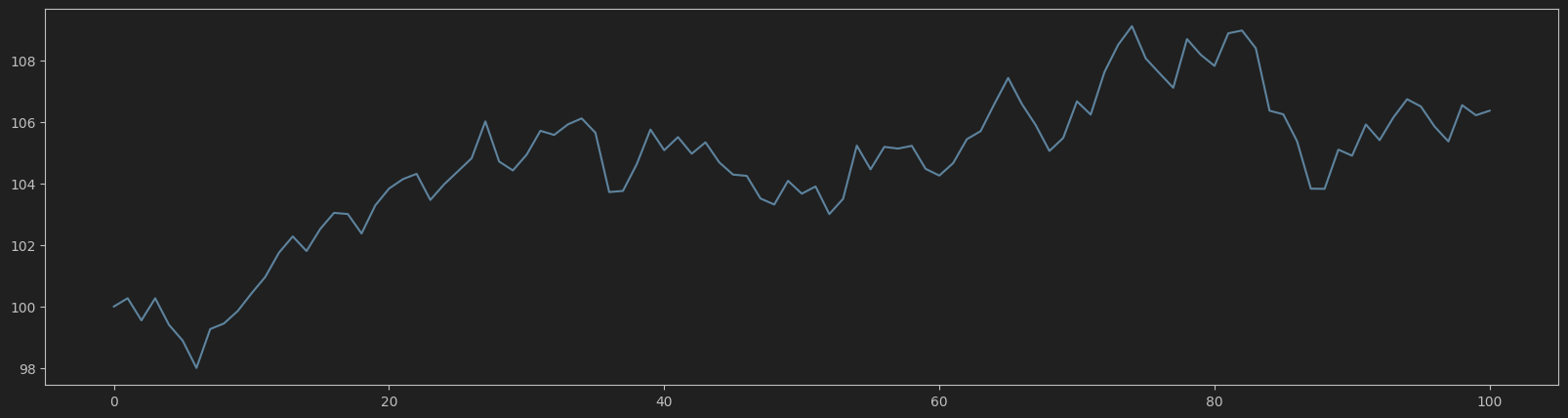
This starts the simulation at state , runs iterations, and then plots the result. As an example, we get the result